Inside El Salvador’s prisons

June 21, 2026
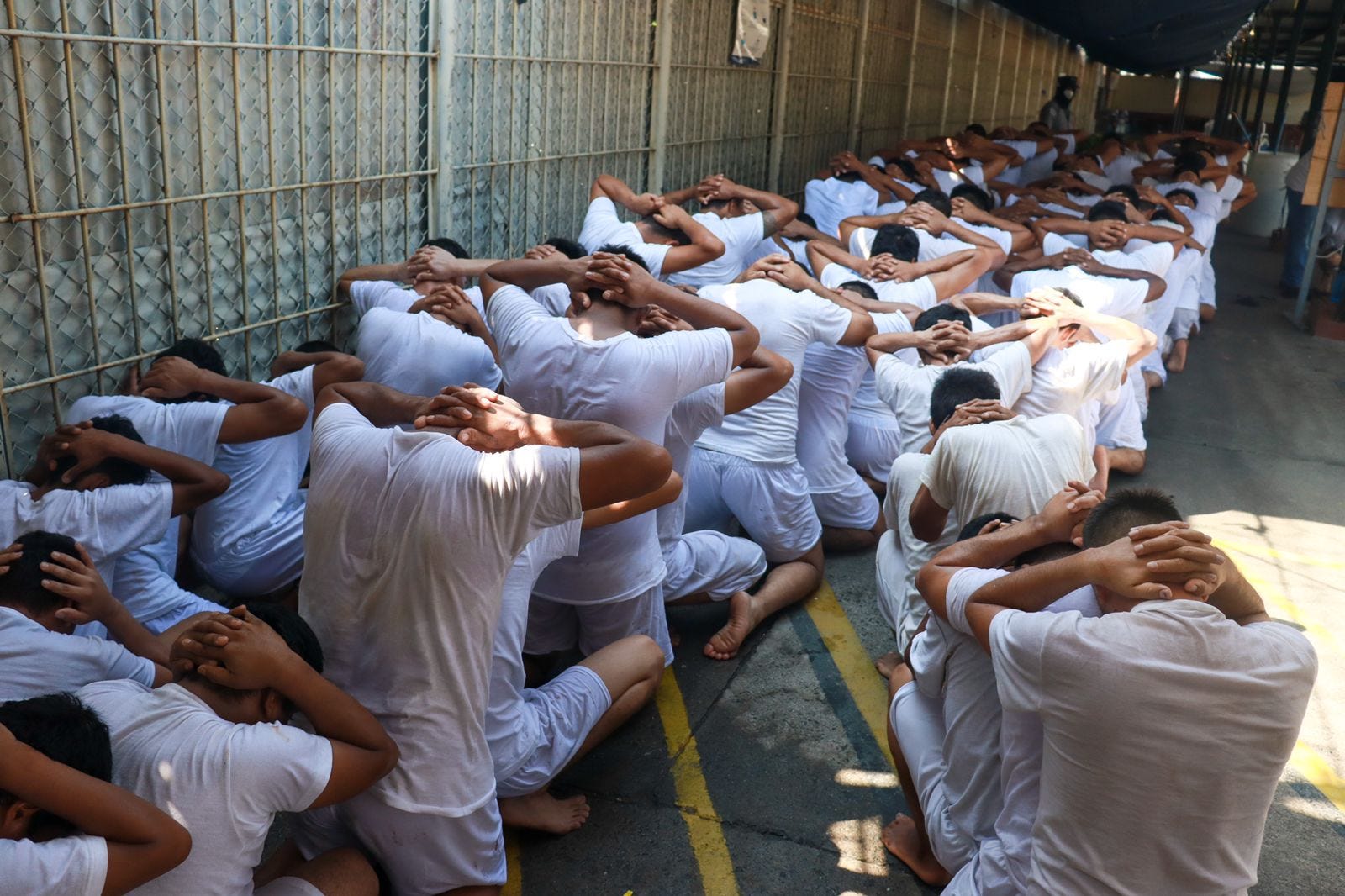
Two percent of the Salvadoran population is currently behind bars in the country’s prison system. That tally is the most prominent cost of the ongoing State of Exception in El Salvador. What happens within prison walls is supposed to be a state secret, but survivors and journalists have been able to expose some of the horrors.
The dramatic overcrowding of the prisons was one focus of the recently released human rights report for 2025 from the Human Rights Observatory (OUDH) of the University of Central America in El Salvador.
From the executive summary of the OUDH report:
The report estimates that, as of December 2025, there were 118,369 individuals deprived of liberty held in prison facilities. With an estimated national population of 6,029,976, the incarceration rate comes out to 1,963 incarcerated persons per 100,000 inhabitants.
The pre-existing prison system now operates with an estimated overcrowding rate of 336%. This implies that the facilities existing prior to CECOT—with a capacity for 30,864 people— house approximately 103,837 inmates; that is, more than 3.3 times their capacity.
[The new mega-prison] CECOT has an estimated population of [only] 14,532 prisoners, equivalent to 36% of its stated capacity of 40,000.
The OUDH report is forced to speak in terms of estimated prison population — the government has placed under seal all information about what happens in the prisons — who enters, who lives, and who dies.
With one out of every 50 Salvadorans held inside the country’s prisons, the country now leads the world in its incarceration rate. The vast majority of those in prison have not been convicted of any crime, since the Bukele government is just starting the trials of persons captured since 2022 during the State of Exception.
Journalists have worked to document some of the horrific conditions inside despite the government’s refusal to share information. In October 2025, El Faro published From the Bowels of Bukele’s Prisons: Survivors Recount Death, Torture, and Starvation, a video report with testimonies of what is experienced within the prisons, told by some who were subsequently released. Said one of the survivors:
They threw gas at us; they said it was part of the welcome. They said that the first night was not a time for sleeping, but to suffer. One case in particular really hurt me so much. It was that of a boy who died at the end of June, but he died from the same beating that he was given when he entered the prison. When he entered, they had broken some of his ribs.
That boy was one of many who do not survive imprisonment even to the date of their trials. The most recent tally of documented deaths in the prisons under the State of Exception from Socorro Juridico Humanitario is 537 as of June 17, 2026. SJH has made available in English translation here a copy of its most recent report regarding prison deaths.
New reporting from El Faro illustrates why most observers believe that 537 could be a gross undercount of the actual death toll. In No Trial, No Funeral: The Bukele Regime Buries Unconvicted Prisoners in Mass Graves, we learn the stories of individuals who died in prison and were then buried in mass graves without their families being notified at the time of their deaths:
In this investigation, the newspaper reconstructs the story of three detainees held by the regime who died in state custody and were buried in mass graves. All showed signs of a violent death, a fact ignored in the forensic reports. All were legally innocent because they had not been convicted in court. The state buried the bodies without informing their families. Families continued to bring packages containing basic supplies to the prisons where they believed their relatives were being held, and the prison system accepted them without hesitation. The state received packages intended for the dead.
The state of exception prohibits family visits and communication between detainees and their lawyers. Furthermore, the prison system accepts the packages but provides no assurance to family members that their relatives received them.
A tiny crack in the communication blackout from those within the prisons was explored in Cartas desde el inframundo (Letters from the underworld), published by CAP, a professional journalism collective for Central America. The report shares the contents of several letters written by individual prisoners and smuggled out of Salvadoran prisons. The letters are the only indication that their families have that loved ones were still alive inside. Because all communication with families and lawyers outside the prisons is prohibited, families pay $50 or more to a corrupt network of “cables” or prison insiders who will get these handwritten messages out. The letters talk of isolation and the pain of having no knowledge of their families outside. They pass on other messages to families of other prisoners who died inside. They share information about the receipt of food and hygiene packets for which families are paying more than $100 per month.
A central narrative of the Bukele regime in El Salvador is the reduction in the homicide rate under the State of Exception. That reduction in the homicide rate does not include, however, the 537 (plus an unknown number more yet to be documented) who have died in Salvadoran prisons. It does not include the innocent persons whose disappearance into Salvadoran prisons is death-like for families who are deprived of knowledge about their conditions, deprived of their presence in the household, and deprived of their economic contribution. A lucky few may be able to pay to receive letters from the underworld, but the rest suffer, never knowing whether the silence from within is imposed by the system or by death.
[I’m trying out a new format for El Salvador Perspectives, which will include a main topic, but also links to other news story of interest]
Other News Around El Salvador
Giant Inflatable Football Breaks Loose, Rolls Through El Salvador Streets (ABP)
Latin American mercenaries fight with Sudan’s paramilitaries amid civil war (El PAÍS). Mercenaries from El Salvador have reportedly died in the fighting.
400 stadiums full of trash pollute San Salvador rivers and drains, city hall says (LPG)
Photo of the Week